Trainee Reporter Kaveri Mishra
India’s education system is shaped by rapid technological change, evolving job markets, and growing expectations for inclusive learning. The National Education Policy (NEP) 2025 responds to these shifts with a forward-looking framework that seeks to modernize how students learn, how teachers teach, and how schools function. It is a step towards improvement of India’s education system. It builds on the changes started in NEP 2020 with an aim to help students get ready for a fast-changing world. NEP 2025 brings some important new updates and fixing problems faced while putting the earlier policy into action.
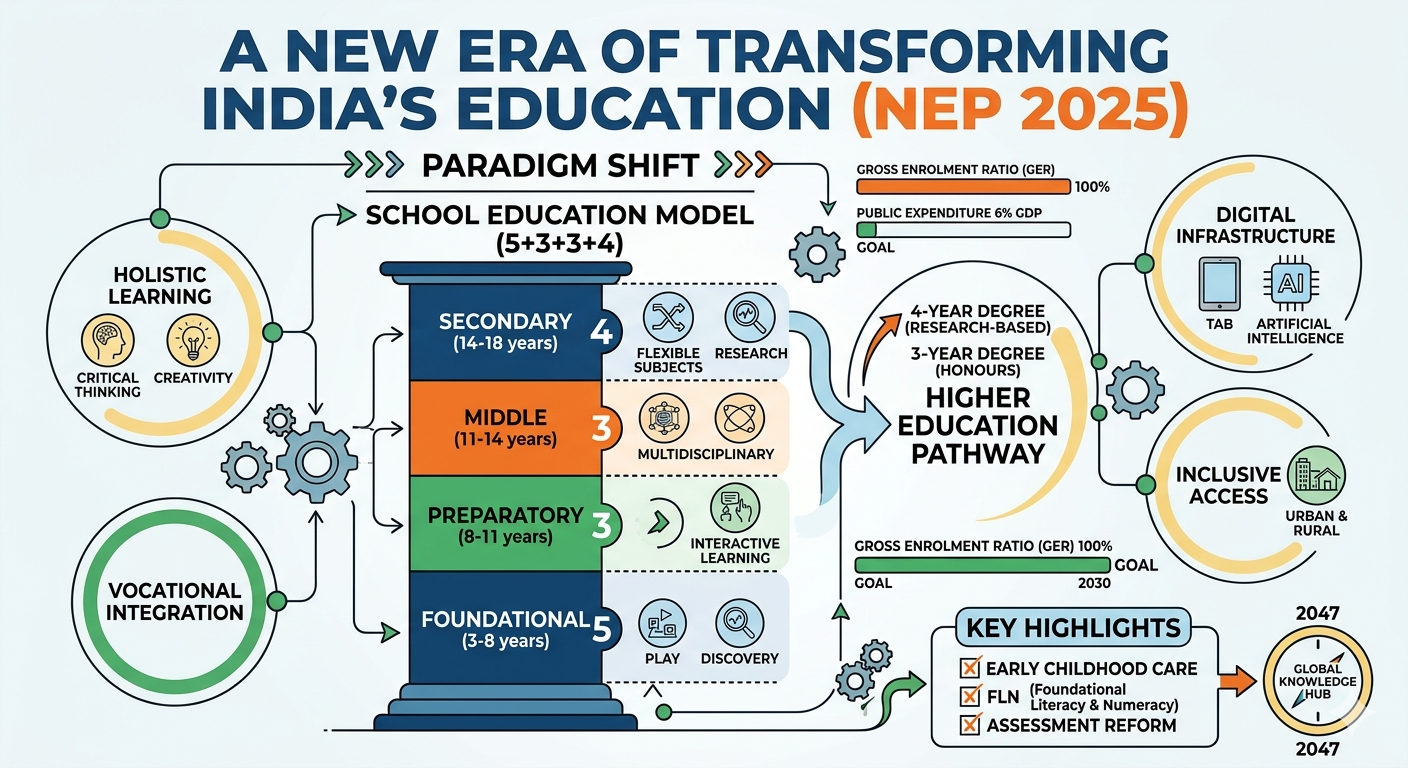
India’s education system needed a transformative refurbishment to address out-dated curricula, rote learning, and limited access to quality education. The NEP, first introduced in 2020, aimed to align education with 21st-century demands, emphasizing skill development, inclusivity, and digital integration. Advocating holistic learning, digital integration, and vocational training to align education with 21st-century needs, the policy aimed to achieve 100% Gross Enrolment Ratio (GER) in school education by 2030 and make India a global knowledge hub by 2047. NEP 2025 aims to build a strong, inclusive foundation for quality education across the country, centred on modern teaching methods and equal opportunities for all learners.
PARADIGM SHIFT
NEP 2025 is a bold plan for India’s education future. The policy is a blueprint to transform the education ecosystem in India. Through empowering schools to innovate and focus on equity, it sets the stage for a generation of learners poised to lead in a world of complexity. Khagendra Kumar, HOD, Education, Patna University, says, “The NEP 2025 plans to formalise Early Childhood Care and Education (ECCE) as a structured play-based learning program for children aged 3 to 6 years. Prioritisation gives attention to foundational literacy and numeracy development and aims to identify and repair gaps in learning as soon as possible. The curriculum has been streamlined to support critical thinking, creativity and problem-based learning, while allowing a multidisciplinary approach, including unusual and innovative combinations of subjects (e.g., combining the arts and sciences). Experiential and inquiry-based learning prompts schools to adopt hands-on teaching methodologies, making learning interesting and relevant.”
He further adds, “However, there is some confusion with regard to higher education, specially in undergraduate 4-year degree course as students who score 7.5 CGPA or more, will be entitled for a degree with research. They can straight away join PhD course instead of pursuing Master’s degree. However, honours degree is also being awarded to students who take only 3 years course.” He is hopeful that with the passage of time, things would simplify and make the entire structure more clear for both the students and the teachers.
WAY AHEAD
NEP 2025 aims is to reshape schools into supportive spaces that place children’s learning at the center, requiring investment in facilities such as laboratories, libraries, and digital resources, often through collaboration between the public and private sectors. However, challenges like resistance to change, gaps in skills, uneven infrastructure, ensuring that foundational literacy and numeracy remain at the core of India’s education transformation. There are infrastructure gaps as rural schools lack digital resources and trained teachers. Remote areas face a deficit of qualified educators. Also, there is shortage of funding as public expenditure on education is below 6% of GDP.
To address these issues, school leaders must build trust with teachers, involve parents, and mobilize the wider community to move forward together.
The National Education Policy 2025 outlines an ambitious vision for the future of education in India. By encouraging schools to adopt innovation, prioritize inclusivity, and integrate technology, it aims to prepare a new generation of learners capable of navigating an increasingly complex world. The success of this vision ultimately depends on school leaders, who must take initiative and turn policy goals into practical outcomes.
Key Highlights of NEP 2025
- It continues the vision of NEP 2020 with the addition of practical steps in implementing it.
- More focus on early childhood education would result in the right age of foundational skill development.
- This focuses on digital education, vocational training, and inclusiveness so that no student is left behind.
- The policy aims to bridge the gap that exists between rural and urban education, as it addresses issues of accessibility and equality.
- Restructuring School By 5+3+3+4 model
- Foundational Literacy And Numeracy
- Flexible and Multidisciplinary Curriculum
- Teacher Education Reforms
- Assessment Reform