Trainee Reporter Kaveri Mishra
Education has always played a central role in India’s approach to national development. Acknowledging its importance in building an equitable, inclusive, and knowledge-based society, successive governments after independence introduced a series of education policies aimed at strengthening the sector. These policies focused not only on increasing access to education but also on enhancing its quality, fairness, and relevance to the country’s social, economic, and global aspirations.
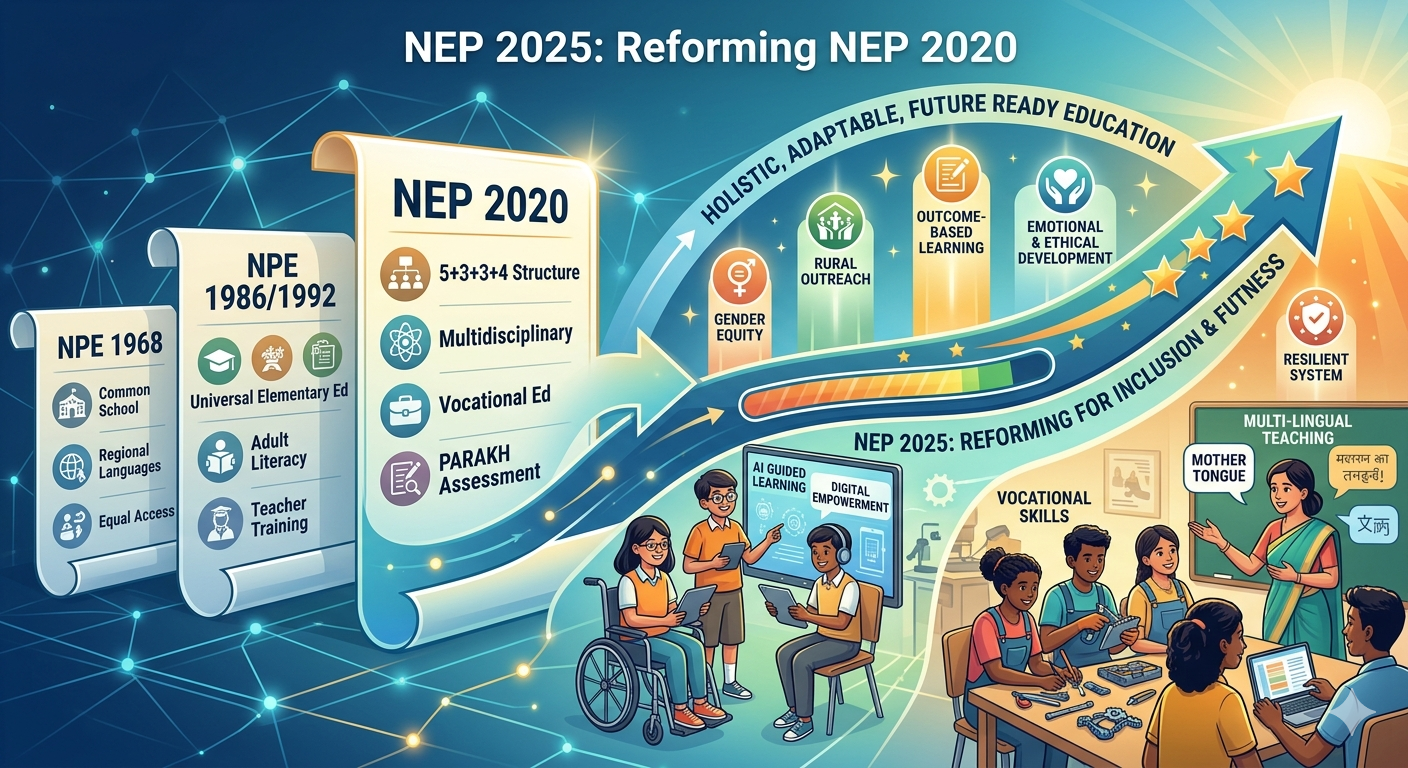
Over time, India’s educational reforms have largely been shaped by three important policy frameworks: the National Policy on Education (NPE) 1968, the revised NPE 1986/1992, and the National Education Policy (NEP) 2020. The NPE 1968, introduced as the country’s first post-independence education policy, was based on the recommendations of the Kothari Commission (1964–66). The policy highlighted the importance of creating a common school system, encouraging regional languages, and ensuring equal access to education for disadvantaged and marginalized sections of society. Its objective was to build a national educational structure that promoted consistency while also recognizing India’s rich linguistic and cultural diversity
The NPE 1986, later updated in 1992, brought significant reforms to the education sector. Its primary goals included the universalization of elementary education, promotion of adult literacy, encouragement of women’s education, and improvement in the quality of teaching and teacher training. This National Education Policy 2020 was the first education policy of the 21st century that addressed the many growing developmental imperatives of our country.
LANDMARK SHIFT
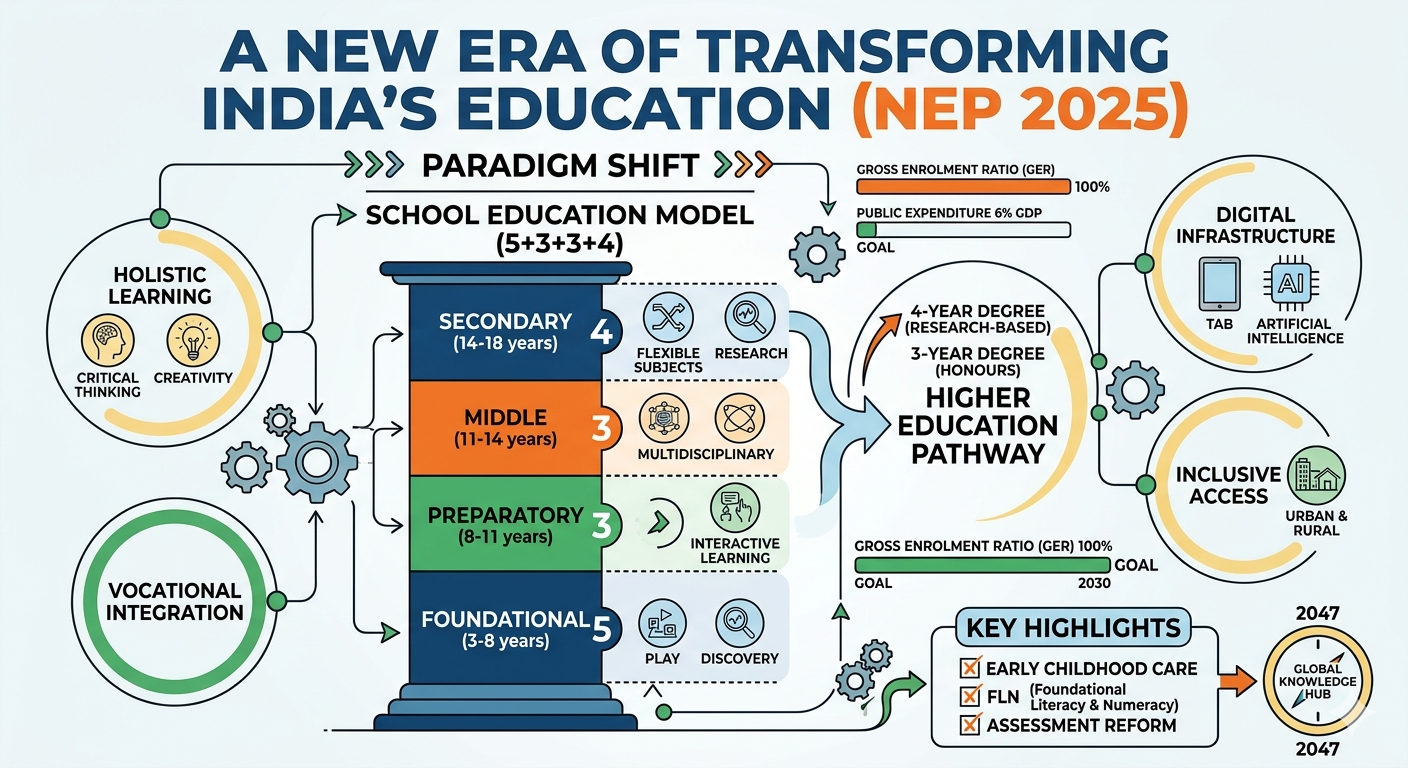
EP 2025 promises a comprehensive strategy to enhance quality, accessibility, and inclusion in education at all levels and follows the changes of NEP 2020. The goal is to create a system of education that prepares students for the problems of the future by promoting multifaceted, adaptable, and holistic learning. Sujata Chandra, Vice Principal, Indian Public School, says, “NEP is a paradigm shift in India’s education system .It gave a final shape to the 5+3+3+4 structure. This new approach to human resource will raise India and keep it at par with the rest of the world. It focuses on foundational literacy, vocational training and AI guided personalized learning. It had revolutionized the way for holistic development of our resources by incorporating PARAKH (Performance Assessment Review and Analysis of Knowledge for Holistic development. PARAKH is an assessment strategy which is a far evolved method than the earlier ones. This also has a multi-disciplinary approach to education. This has reduced the barriers between arts science and commerce. New pedagogical method and means of cognitive development too has been ushered in.” She adds, “Skill based vocational training will cater to the employment market and reduce the mismatch between job requirements and the education system and make it more relevant. This new approach will help India stride in the arena of development with flying colours.”
STRUCTURAL REFORMS
While NEP 2020 introduced interdisciplinary learning and vocational training, NEP 2025 builds on this by emphasizing inclusivity, accessibility, and quality education through innovative teaching, technology, and support for marginalized groups. The policy prioritizes outcome-based learning, digital empowerment, gender equity, and rural outreach. NEP 2025 seeks to address systemic gaps while promoting students’ emotional, ethical, and academic development. Its successful implementation depends on strong collaboration among all stakeholders to build a resilient, inclusive, and future-oriented education system for the 21st century. The policy introduces a 5+3+3+4 curricular structure that aligns education with the cognitive and developmental stages of children aged 3 to 18 years. It also emphasizes multidisciplinary learning, regional language instruction, vocational education from Grade 6 onward, and digital integration to modernize India’s education system. Furthermore, NEP 2025 upholds the three-language formula, encouraging the use of the mother tongue or regional language as the medium of instruction at least until Grade 5, and preferably until Grade 8. English and other languages are introduced gradually to ensure deeper understanding and stronger foundational learning.
COMPARISON BETWEEN NEP 2020 AND NEP 2025
| Basis of Comparison |
NEP 2020 |
“NEP 2025” (Implementation Updates) |
| Nature of Policy |
Introduced as a new national education framework in 2020 |
Refers to the on-going implementation and progress of NEP 2020 reforms |
| School Structure |
Replaced the traditional 10+2 system with the 5+3+3+4 model |
Wider adoption of the 5+3+3+4 structure in schools |
| Teaching Approach |
Focused on conceptual understanding instead of rote learning |
Increased use of activity-based and competency-based teaching methods |
| Medium of Instruction |
Encouraged teaching in mother tongue or regional language till Grade 5 |
More schools implementing multilingual teaching practices |
| Skill Development |
Introduced vocational education from middle school level |
Greater emphasis on coding, internships, and practical skills |
| Assessment System |
Proposed holistic and competency-based assessments |
Gradual shift toward continuous and skill-oriented evaluation methods |
| Technology in Education |
Promoted digital learning and online educational resources |
Expanded use of smart classrooms, AI tools, and e-learning platforms |
| Higher Education |
Encouraged multidisciplinary education and flexible degree programs |
Universities implementing four-year degree programs and multiple exit options |
| Teacher Training |
Focused on improving teacher education and professional development |
More training programs for digital and modern teaching methods |
| Current Status |
Official national education policy |
Not a separate policy; represents the present implementation phase of NEP 2020 |