Education
The OSM Debate: Why CBSE’s Digital Evaluation System Is Under Fire
Published
2 days agoon
Authored by Trainee: Kaveri Mishra
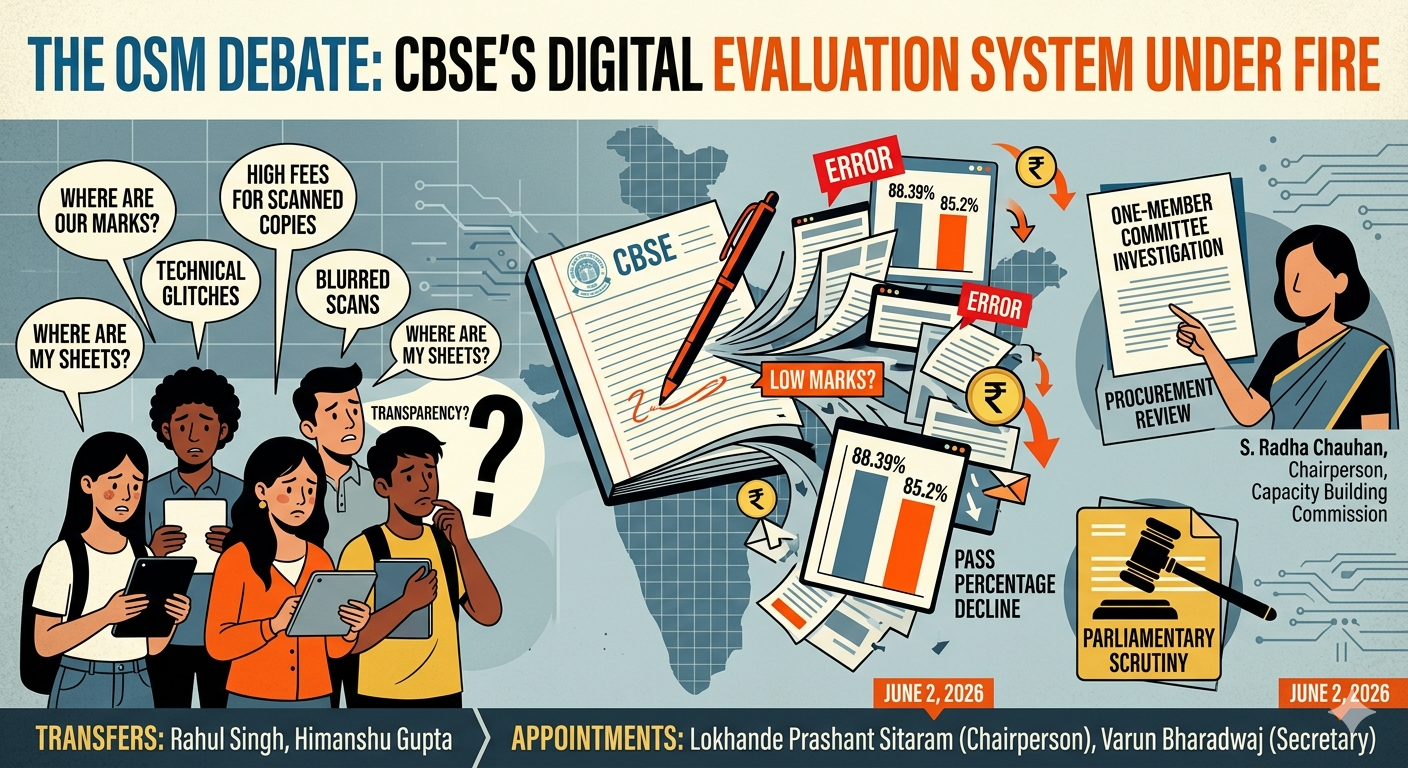
CBSE’s transition to the On-Screen Marking (OSM) system came under intense scrutiny after a sharp rise in student complaints over lower-than-expected marks, difficulties in the answer-sheet verification process, and the cost of obtaining scanned copies of evaluated scripts. The controversy had since expanded beyond examination results, raising broader questions about the system’s implementation, transparency, and procurement process.
Amid the ongoing controversy surrounding the On-Screen Marking System, the Central Government on June 2, 2026 transferred CBSE Chairman Rahul Singh and Secretary Himanshu Gupta. Within hours of issuing the transfer orders, the Centre announced the appointment of Lokhande Prashant Sitaram as the new Chairperson of the Central Board of Secondary Education (CBSE) and Varun Bharadwaj as its new Secretary.
Rahul Singh has been appointed as Additional Secretary in the Department of Agriculture and Farmers Welfare. Himanshu Gupta has been repatriated to his parent cadre in the Ministry of Home Affairs with an ‘extended cooling-off’ condition. According to the Cabinet order, Gupta will be eligible for another central deputation only after December 2030.
Meanwhile, the government has constituted a one-member committee to investigate issues related to the procurement of services for the On-Screen Marking System by CBSE. The committee will be headed by S. Radha Chauhan, Chairperson of the Capacity Building Commission.
Controversy and beyond
Under the new OSM framework, approximately 98.66 lakh answer sheets were scanned and evaluated digitally by nearly 70,000 evaluators across the country. Following the declaration of the CBSE Class 12 results on May 13, 2026, the overall pass percentage declined from 88.39% in the previous year to 85.2%, triggering concerns among students and parents.
Simran Shah, a student affected by the OSM, says, “A large number of complaints surfaced on social media, with students alleging that they had received unexpectedly low marks, particularly in core subjects such as Physics, Chemistry, Biology, and Mathematics. Students and teachers also criticised the board for charging substantial fees for providing photocopies of answer sheets despite the answer books already being available in scanned digital format. In response to the criticism, the board subsequently reduced the applicable fee.””
As students applied for scanned copies through the board’s verification process, several technical issues were reported, including payment gateway failures, incorrect fee deductions, and delays in accessing answer sheets. CBSE stated that its portal experienced unprecedented traffic volumes and multiple attempts at unauthorised interference. The original deadline of May 22 for providing scanned copies was extended several times, eventually until May 25, 2026.
The board received 4,04,319 applications for scanned copies of answer books, significantly higher than the previous year. While the increase reflected heightened demand for verification, several students who obtained copies reported issues such as blurred scans, missing pages, and, in some instances, receipt of another student’s answer sheet.
Ethical hackers blew the whistle
The controversy surrounding CBSE’s newly introduced On-Screen Marking (OSM) system gained momentum on May 22 when 19-year-old student and ethical hacker Nisarga Adhikary published a blog post highlighting alleged vulnerabilities in the platform.
In his analysis, Adhikary examined the portal’s code and claimed to have identified multiple security and technical flaws. The OSM system, introduced for the evaluation of Class 12 Board examinations, enables examiners to assess scanned answer sheets through a centralized online platform. CBSE adopted the digital framework with the stated objective of streamlining and expediting the evaluation process.
Student Invited to Present Views Before Parliamentary Committee
Days later, on May 30, another student, a 17-year-old resident of Ranchi, Jharkhand Sarthak Sidhant, published a separate blog post raising questions about the procurement process behind the OSM system. After reviewing tender documents available on the Central Public Procurement Portal, Sidhant alleged that CBSE had modified certain tender conditions in a manner that favoured Coempt Edu Teck, the private vendor responsible for developing and hosting the OSM infrastructure.
Sarthak Siddhant was invited to appear before a parliamentary committee at Parliament House on Tuesday to present his findings and views on the CBSE’s newly introduced On-Screen Marking (OSM) system.
Siddhant, who appeared for the CBSE Class 12 Board examinations this year, is among the students affected by the implementation of the new digital evaluation framework. His presentation formed part of the committee’s ongoing review of issues related to the conduct and evaluation of the 2026 CBSE Board examinations.
Call for a greater transparency
The controversy surrounding CBSE’s On-Screen Marking system highlights the challenges of rapidly scaling digital reforms in high-stakes public examinations. While the initiative was introduced with the aim of improving efficiency and standardising evaluation, the concerns raised by students, educators, and independent reviewers point to gaps in implementation, transparency, and user experience. As the matter is now under parliamentary and administrative scrutiny, the outcome of the ongoing review is likely to play a key role in shaping how such large-scale digital assessment systems are designed and deployed in the future.
Prachi Sharma is a dynamic journalist and anchor known for her insightful reporting and engaging on-screen presence. With a strong command over storytelling and a flair for content creation, she brings clarity and depth to every piece she presents. Prachi’s versatile skills extend beyond journalism—her ability to craft compelling written content makes her a valuable voice in the media landscape. Whether on camera or behind the scenes, she is committed to delivering impactful narratives that inform, inspire, and connect with audiences.

You may like


Modernizing Governance: The UGC’s Unified Approach to Institutional Monitoring
-
Delays, Disruptions and Anxiety: How Technical Glitches Marred CUET UG 2026
-
A New Era of Digital Tracking in Higher Education: UAMP Is Revolutionizing Campus Governance in India
-
Merging Theory with Experience: UGC’s Professor of Practice Initiative Brings Industry Expertise to Indian Universities
-
Standardizing the Future: An Overview of the National Testing Agency
-
Fostering Academic Excellence: How the Distance Education Bureau Push for Quality Learning Anywhere