Entertainment
‘Hey Kay Navin?’ series review: Varun Narvekar redefines feel-good in this breezy rom-com

Published
2 months agoon
The title of Varun Narvekar’s Marathi rom-com series, Hey Kay Navin?, embodies an intriguing, almost elusive quality that defies direct translation. This common Marathi idiom, casually employed to convey surprise at new life developments, loses its intrinsic charm and meaning when literally rendered into English as ‘What’s this new?’. Even a closer approximation like ‘What’s this now’ fails to capture the multifaceted inflections of the original, which can signify a range of emotions and contexts. It carries an understated, everyday feel, devoid of pretense or sharp edges. Instead, it seamlessly weaves into conversations, acting as a conversational bridge—sometimes playful, sometimes somber, occasionally ironic, and at times, utterly shocked. It serves as an emotional filler, poignant yet subtle, raising the profound question: Can emotions truly be encapsulated by language? Can love be precisely measured in words?
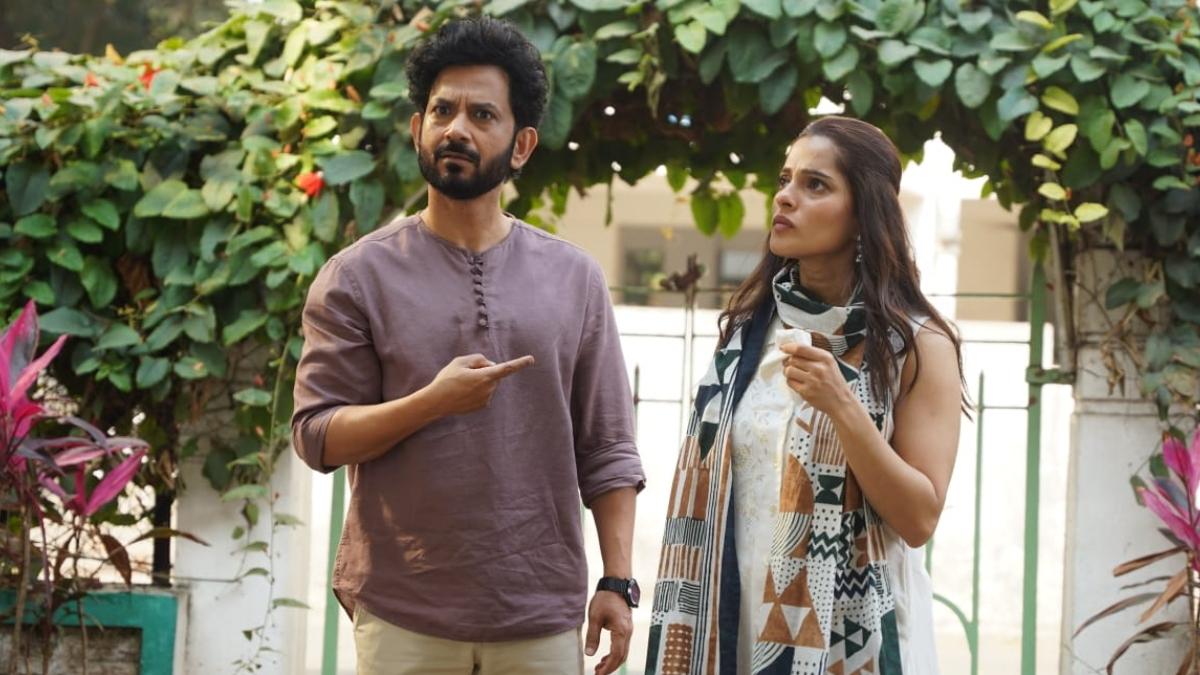
This very struggle with articulating inner emotional landscapes resonates deeply with Rama (Priya Bapat), the series’ protagonist. Trapped within the confines of her own mind, Rama finds it challenging to dissect and express her innermost feelings. This internal conflict propels her to take a sabbatical from her demanding corporate career and embark on the entrepreneurial journey of launching her own clothing brand. Her supportive, albeit perpetually good-natured, husband Aditya (Umesh Kamat) stands by her, even as she navigates the critical disapproval of her mother, who struggles to comprehend Rama’s unconventional career shift. “I am weary of the mundane; I yearn for something new in life,” Rama articulates, and indeed, ‘new’ experiences and encounters unfold, compelling her to re-evaluate the ‘old’.
Directed by Varun Narvekar, Hey Kay Navin? features a talented cast including Priya Bapat, Umesh Kamat, Shubhangi Gokhale, and Uday Tikekar. Comprising eight episodes, each with a duration of 25-33 minutes, the series offers a compelling synopsis: A working woman in her late thirties opts for a corporate sabbatical to establish her clothing brand, confronting significant emotional shifts within her marriage during this transformative period.
Initially, the series unfolds with the effortless charm of a breezy sitcom, reminiscent of the early seasons of Dhruv Sehgal and Mithila Palkar’s Little Things. In this phase, conflicts are neatly resolved within each episode, and the narrative stakes appear relatively low. However, the couple in Hey Kay Navin? occupies a distinct life stage; their love, having already blossomed, now faces the delicate phase of shedding its initial leaves. This nuanced dynamic fuels Rama’s introspection as she compares her relationship with that of other couples. The authentic bond between Rama and Aditya forms the unwavering anchor of the show, meticulously crafted by Varun Narvekar, who ensures genuine moments without prematurely burdening the plot with undue complexities. The screenplay maintains a distinctive rhythm, at times adopting the quirky cadence of a YouTube sketch, while reserving its profound emotional heavy lifting for later episodes.
This distinctive narrative style is a hallmark of Narvekar’s previous works, including the stirring romantic dramas Muramba (2017) and 1234 (2023), both characterized by an underlying current of humor beneath their serious themes. Varun’s approach to deconstructing relationships often feels almost scientific, as he meticulously delves into situations, examining their causes and effects through candid, free-flowing conversations that expose the subtle fissures within a bond. Muramba, for instance, is virtually structured as a sustained dialogue between a young man and his parents, who endeavor to persuade him to reconcile with his recently estranged girlfriend. Similarly, in Hey Kay Navin?, moments of intense confrontation emerge, which Varun handles with remarkable equilibrium, ensuring that the raw intensity of these emotions does not overpower the overall aesthetic and narrative balance.
Rama stands at the very epicenter of this intricate exploration. Her character possesses a depth that extends far beyond initial perceptions, revealing moments of profound uncertainty and confusion as she endeavors to build her new brand. Varun frames her skepticism with considerable care, steadfastly avoiding simplistic resolutions. Priya Bapat’s portrayal of Rama is equally nuanced and graceful, effortlessly embodying her character’s anxieties and joys. Her performance is beautifully complemented by Umesh Kamat, her real-life partner, whose wholesome on-screen chemistry provides a compelling and authentic depiction of a healthy, evolving relationship.
Md Mudassir Siddiqui is a distinguished computer science expert with a robust background in cutting-edge research and scholarly pursuits. As a research specialist, he has made significant contributions to the field, exploring innovative technologies and their applications. A passionate media enthusiast, Mudassir brings a creative flair to his work, with a specialized focus on new media. His expertise spans digital platforms, emerging media trends, and interdisciplinary projects that bridge technology and communication.

You may like


‘Normal’ movie review: Bob Odenkirk powers a darkly comic small-town shootout
-
Y.Gee. Mahendra’s new play is a sequel to Sivaji Ganesan’s popular film Paritchaikku Neramachu
-
‘Trevor Noah: Joy in the Trenches’ review: Noah asks the tough questions, but makes you laugh anyway
-
‘Beef’ Season 2 review: Too many cooks, not enough meat on the bone
‘Kaakkee Circus’ series review: Sans big names, this series is a ‘slow burn’ comedy
-
Pallichattambi movie review: Heavy-handed approach drags down this ahistorical period movie