Education
From Campus to Cloud: How SWAYAM is Democratizing Higher Education
Published
4 hours agoon
Trainee Reporter Adarsh
India’s education system is the world’s third-largest and is also characterized by high enrollment rates, but it is highly plagued by deep disparities in quality, and presents a striking contrast of massive scale and rapid growth, heavily overshadowed by systemic inequalities, learning poverty, severe foundational learning deficit, and a traditional or persistent focus on rote learning.
The Challenges Facing India’s Education System
The Reality of Student Learning: Major studies like the ASER reports highlight that many students in elementary classes struggle with basic reading and arithmetic.
The Culture of Competition: The system is heavily examination-oriented with massive focus on grades and intense competition leaving little room for creative thinking or overall holistic growth.
The Quality Gap: Thus, while higher education has expanded significantly, and access and enrollment have also improved, however, the overall quality remains highly variable, and the system often struggles with employability and inadequate resources in public schools.
The Strategic Shift: Policy & Digital Transformation
However, the Indian government is actively implementing policies to address these structural issues by promoting vocational training, multidisciplinary learning, and integration of regional languages. The government is trying to fundamentally transform the education system through different policies and strategies such as the National Education Policy (NEP) 2020, or by expanding access through major digital and financial initiatives like PM eVidya and the PM VidyaLakshmi Scheme.
These strategies and policies focus on shifting from rote learning to competency-based education, thus to improve education system in India. Meanwhile, initiatives like SWAYAM expand free digital learning and Massive Open Online Courses (MOOCs) to different areas.
Such digital initiatives are fundamentally transforming India’s education system by bridging the gap between rural and urban sectors, standardising curricula, and lowering the financial barriers to quality education. Driven by the vision of the National Education Policy (NEP), the integration of digital tools has evolved education from a rigid, classroom-bound framework into a dynamic, flexible, and multi-modal ecosystem.
SWAYAM (Study Webs of Active-Learning for Young Aspiring Minds)
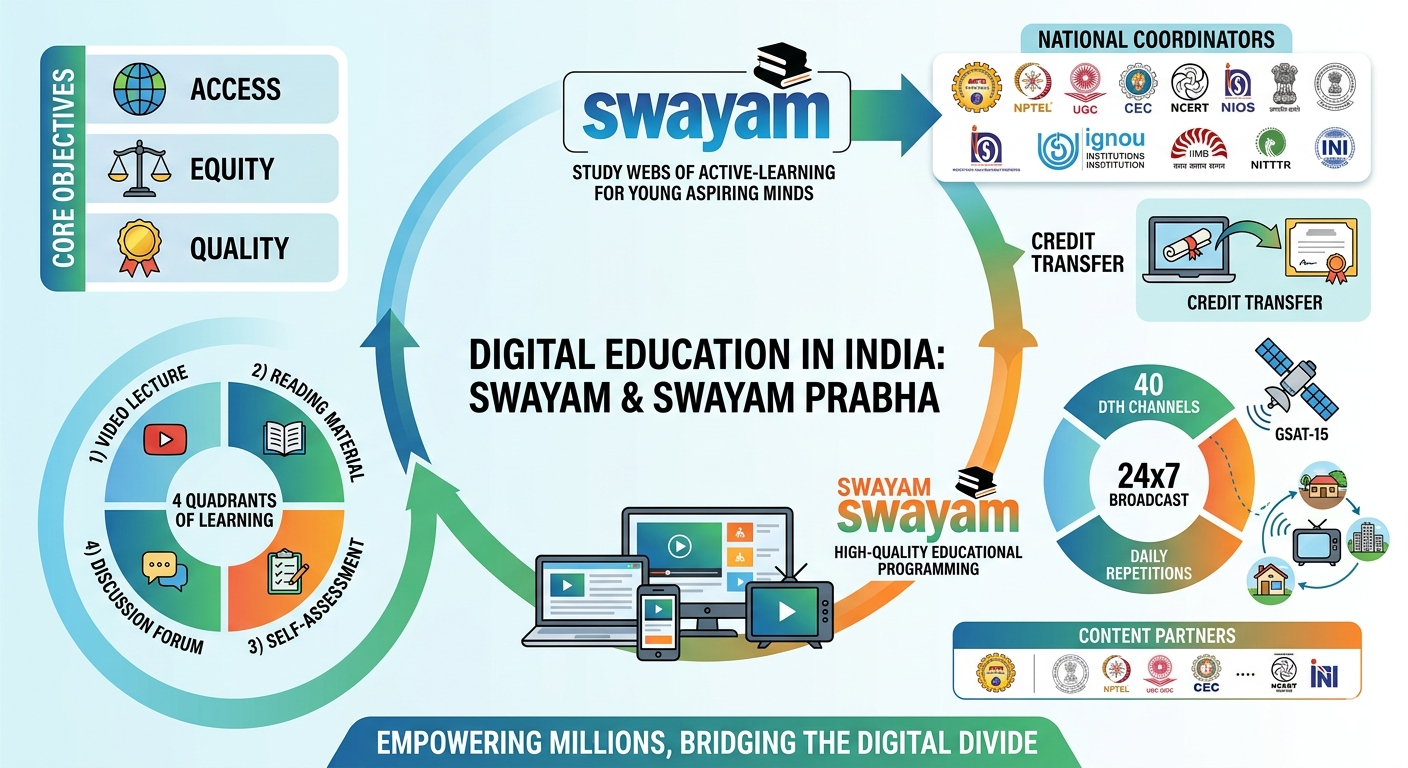
SWAYAM is a programme spearheaded by the UGC and initiated by Government of India. It was launched on July 9, 2017 by the Ministry of Human Resource Development to provide one integrated platform and portal for online courses. It is designed to achieve the three cardinal principles of Education Policy viz., access, equity and quality.
Objectives & Impact
Reaching the Disadvantaged: The objective of this effort is to take the best teaching learning resources to all, including the most disadvantaged.
Bridging the Digital Divide: SWAYAM seeks to bridge the digital divide for students who have hitherto remained untouched by the digital revolution and have not been able to join the mainstream of the knowledge economy.
Democratizing Education: It democratizes education, bringing high-quality, free learning Equal Access to Quality Education from top educators to anyone, regardless of their location or financial background.
Removing Barriers: Course enrollment and learning materials are entirely free, removing financial barriers for economically disadvantaged learners.
Scope of Learning: It provides a single, coordinated online portal offering courses that range from high school (Class 9) to postgraduate and skill-development sectors.
Formal Integration & Credit Transfer: The platform is not just for casual learning; it integrates with India’s formal university ecosystem. Through the University Grants Commission (UGC) regulations, regular college students can complete courses on SWAYAM and transfer those academic credits directly to their degrees. This makes the higher education path highly flexible.
The 4 Quadrants of SWAYAM Courses
The courses hosted on SWAYAM are in 4 quadrants:
Video lecture
Specially prepared reading material that can be downloaded/printed
Self-assessment tests through tests and quizzes
An online discussion forum for clearing the doubts
The 10 National Coordinators
In order to ensure that best quality content is produced and delivered, ten National Coordinators have been appointed. They are:
AICTE (All India Council for Technical Education): for self-paced and international courses
NPTEL (National Programme on Technology Enhanced Learning): for Engineering
UGC (University Grants Commission): for non technical post-graduation education
CEC (Consortium for Educational Communication): for under-graduate education
NCERT (National Council of Educational Research and Training): for school education
NIOS (National Institute of Open Schooling): for school education
IGNOU (Indira Gandhi National Open University): for out-of-school students
IIMB (Indian Institute of Management, Bangalore): for management studies
NITTTR (National Institute of Technical Teachers Training and Research): for Teacher Training programme
INI (Institutes of National Importance): for Non-Technical Courses
SWAYAM PRABHA
SWAYAM PRABHA, whose name translates to “self-shining”, was established to make quality education accessible to every corner of India. It is an initiative of the Ministry of Human Resources Development which launched it on 7 July 2017 to provide high-quality educational programming to students across the country through a bouquet of 40 Direct-to-Home (DTH) television channels across the length and breadth of the country on 24X7 basis via the GSAT-15 satellite.
Key Features & Infrastructure
No Internet Required: The platform aims to bridge the digital divide by delivering academic content to students, especially those in remote areas without internet access. It relies on satellite broadcasting, hence, it eliminates the need for broadband connections, costly data plans, or reliable Wi-Fi.
Portal Monitoring: While the lectures are broadcast on television, the master web portal for the program is maintained and monitored by the INFLIBNET Centre, an autonomous Inter-University Centre of the UGC.
Flexible Broadcast Schedule: New educational content is broadcast for at least four hours every day. This daily curriculum is then repeated five more times throughout the same day. This repetition allows students to tune in and learn at the time that best fits their personal schedule.
Diverse Disciplines: The platform covers a vast array of disciplines, including arts, science, commerce, engineering, law, medicine and vocational training, catering to everyone from school-level students to postgraduate scholars with curriculum-based course content.
Content Providers: The high-quality study materials and lectures are provided by expert institutions such as the Indian Institutes of Technology (IITs), the University Grants Commission (UGC), the Consortium for Educational Communication (CEC), IGNOU, NCERT, and NIOS.
Prachi Sharma is a dynamic journalist and anchor known for her insightful reporting and engaging on-screen presence. With a strong command over storytelling and a flair for content creation, she brings clarity and depth to every piece she presents. Prachi’s versatile skills extend beyond journalism—her ability to craft compelling written content makes her a valuable voice in the media landscape. Whether on camera or behind the scenes, she is committed to delivering impactful narratives that inform, inspire, and connect with audiences.

You may like


CBSE Board Re-evaluation Process: Effects on Academic Performance and Student Confidence
-
Anatomy of a Compromised Exam: From a 400-Question ‘Guess Paper’ to a Nationwide Re-Test
-
Improving Educational Outcomes through Active Stakeholder Participation in Decision-Making in CBSE


Partners in Learning: Empowering Parents and Teachers Together
-
NEP 2025: Reforming NEP 2020 for an Inclusive and Future Ready Educational System
-
A New Era of Transforming Education: Navigating the Paradigm Shift in India’s Education Policy