Education
CBSE Board Re-evaluation Process: Effects on Academic Performance and Student Confidence
Published
3 hours agoon
Trainee Reporter Kaveri Mishra
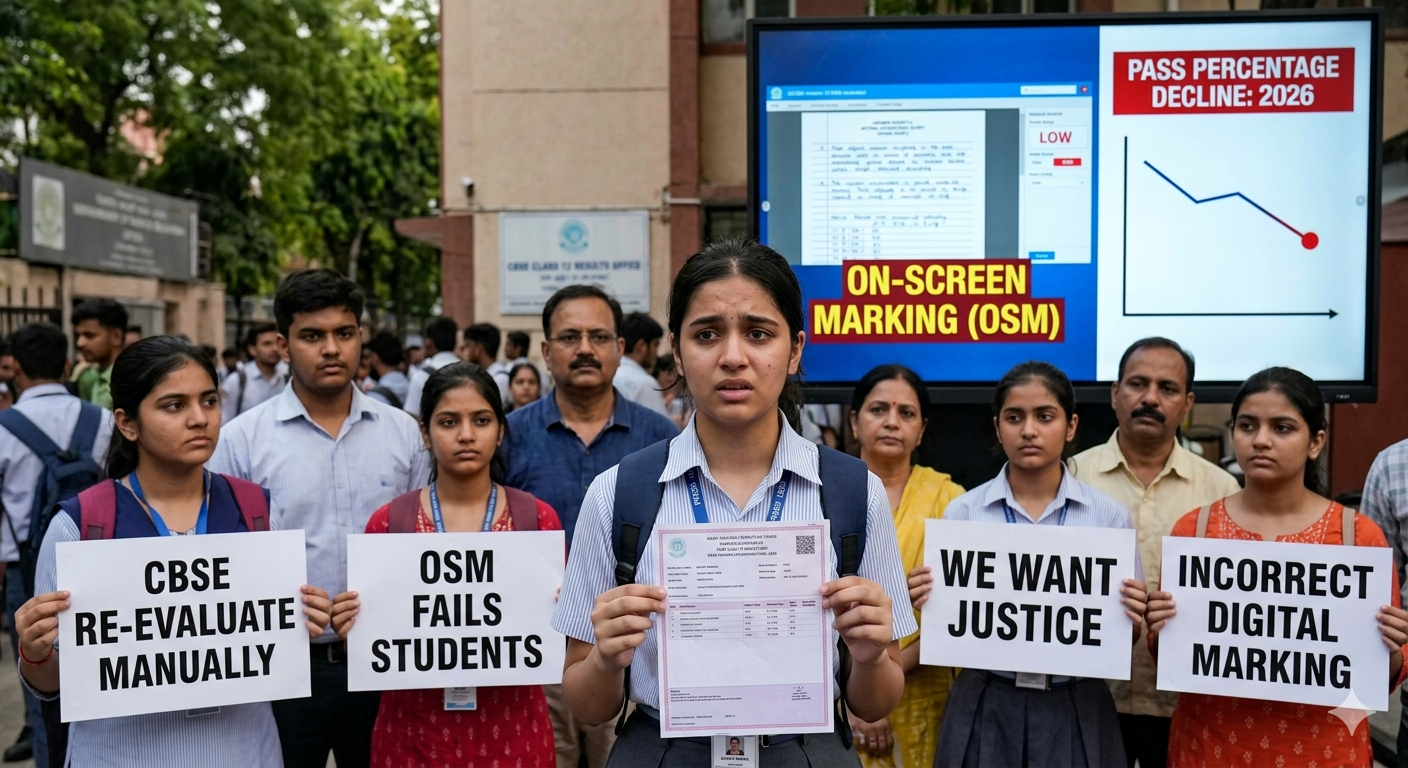
The declaration of the CBSE Class 12 Results 2026 on May 13 came as a shock to thousands of students, especially those from the Science stream, who received marks far below their expectations. The reason behind the unexpected scores is being linked to CBSE’s newly introduced On-Screen Marking (OSM) digital evaluation system.
On-Screen Marking (OSM) is a digital evaluation method in which physical answer sheets are scanned and converted into high-resolution digital copies. Instead of checking papers manually, examiners assess these scanned answer sheets on computer screens.
The system has already been widely adopted by international examination boards such as Cambridge Assessment, International Baccalaureate, and Pearson. CBSE had been testing the system on a limited scale for several years before introducing it more extensively in the 2025–26 academic session.
HOW THE SYSTEM WORKS
OSM is a digital evaluation system in which students’ answer sheets are scanned after the examination and converted into digital copies. These scanned answer scripts are then uploaded to a secure CBSE evaluation portal, allowing examiners to assess them on computer screens rather than checking physical papers manually.
Although students still appear for examinations using the traditional pen-and-paper method, the evaluation of answer sheets is now being carried out digitally.
This change is part of CBSE’s broader initiative to modernise the examination system, enhance accuracy in marking, and speed up the result-processing process. Considering the massive scale of board examinations, which requires the assessment of millions of answer sheets each year, the move is intended to make evaluation more efficient, transparent, and standardised.
STUDENTS REACTION
Students have expressed mixed feelings of frustration and concern regarding the OSM method used by the CBSE in the Class 12 board examinations. Many have criticized the system, stating that it has resulted in unexpectedly lower marks, particularly in subjects such as Physics, Chemistry, Biology, and Mathematics. A large number of students believe that the evaluation process does not accurately reflect their actual performance, contributing to a noticeable decline in overall pass percentages.
They seem also to be concerned about the fairness and consistency of the marking system, with students questioning whether the OSM method is responsible for the discrepancies observed in their results. As a result, many have demanded manual re-evaluation of their answer scripts to ensure that their scores truly represent their academic performance.
The issue has gained significant attention on social media, where students and parents have collectively called for free manual re-evaluation and greater transparency from CBSE regarding its evaluation procedures.
Students claimed that the scanned answer sheets provided by the board were faded, improperly cropped, or difficult to read, raising concerns about whether evaluators could accurately assess their responses. The issue quickly gained attention across platforms such as X, Reddit, Instagram, Telegram, and YouTube, where students and educators criticized the readiness and reliability of the digital evaluation system.
Although CBSE acknowledged the presence of “technical glitches” and extended the application deadlines, the board stated that the OSM process incorporates quality-control measures and was implemented to enhance efficiency and transparency.
TEACHERS’ CONCERN
Some teachers feel that the On-Screen Marking (OSM) system removes the ability to acknowledge student effort and judgment in grading. They feel that the new system’s rigid structure overlooks genuine attempts by students to answer questions, especially if minor errors occur. This shift from physical evaluation to a purely digital interface is causing discomfort among evaluators, who worry that it lacks the human touch needed in educational assessments.
BOARD EXPLAINS:
While the board has acknowledged these concerns, it has also highlighted the advantages of the OSM system, including stepwise marking and automated total calculations designed to reduce human error and improve standardization in evaluation.
At the same time, CBSE clarified that students who are not satisfied with their marks can still make use of the existing re-evaluation process. Students are encouraged to apply for re-evaluation if they feel their marks are not justified. CBSE has also outlined a structured process for the same. Although the OSM method is intended to enhance the assessment system, student feedback suggests that greater transparency and fairness are still required to address on-going concerns effectively.
FIGURES: PASS
The CBSE Class 12 pass percentage for 2026 stands at 85.20%, reflecting a decline of approximately 3.14% compared to the previous year’s 88.39%.
This year, girls outperformed boys by a margin of 6.73%. The pass percentage for girls was 88.86%, while boys recorded a pass percentage of 82.13%. In comparison, the 2025 results showed higher performance, with girls at 91.64% and boys at 85.70%.
Among all regions, the Trivandrum region once again recorded the highest pass percentage at 95.62%. However, even this region experienced a significant drop compared to 99.32% in 2025.
In addition, 94,028 students scored 90% and above, while 17,113 students secured 95% and above in the CBSE Class 12 examinations of 2026.
TIPS FOR FUTURE APPEARING STUDENTS
• Use a dark blue or black pen, as light ink or pencil marks may not scan clearly.
• Maintain neat and legible handwriting since evaluators will read the answers on a screen rather than on paper.
• Follow the marking scheme properly by writing answers in clear points, using headings and proper numbering wherever required.
• Draw diagrams with dark, sharp lines and label them neatly using the correct scale.
• Avoid writing outside the margins because scanners may crop content beyond the designated answer area.
• Minimize overwriting and excessive cutting, as clean presentation becomes even more important in digital evaluation.
• Stick to the exact answer asked in the question, since under OSM, unnecessary extra content is unlikely to fetch additional ‘effort marks’.
Prachi Sharma is a dynamic journalist and anchor known for her insightful reporting and engaging on-screen presence. With a strong command over storytelling and a flair for content creation, she brings clarity and depth to every piece she presents. Prachi’s versatile skills extend beyond journalism—her ability to craft compelling written content makes her a valuable voice in the media landscape. Whether on camera or behind the scenes, she is committed to delivering impactful narratives that inform, inspire, and connect with audiences.

You may like


From Campus to Cloud: How SWAYAM is Democratizing Higher Education
-
Anatomy of a Compromised Exam: From a 400-Question ‘Guess Paper’ to a Nationwide Re-Test
-
Improving Educational Outcomes through Active Stakeholder Participation in Decision-Making in CBSE


Partners in Learning: Empowering Parents and Teachers Together
-
फीस पर लगाम, लेकिन लूट को कानूनी जामा – BNMU Internship Scam
-
NEP 2025: Reforming NEP 2020 for an Inclusive and Future Ready Educational System