Education
CBSE’s Three-Language Mandate: Balancing Policy Goals and Ground Realities

Published
2 hours agoon
Authored by Trainee Reporter: Kaveri Mishra
The Central Board of Secondary Education (CBSE) has announced a revised language policy for Classes IX and X, effective from the 2026–27 academic session. The move is in line with the objectives of the National Education Policy (NEP) 2020 and the National Curriculum Framework (NCF) for School Education 2023.
CBSE’s new language policy for Classes IX and X, to be implemented from the 2026–27 academic session, introduces compulsory three-language learning, internal assessment for the third language, and a greater emphasis on multilingual, stress-free, and skill-based education. The updated framework marks a gradual transition toward multilingual, skill-oriented, and less exam-focused education. He added that the policy is designed to ease academic pressure, strengthen Indian languages, and encourage more inclusive educational practices.
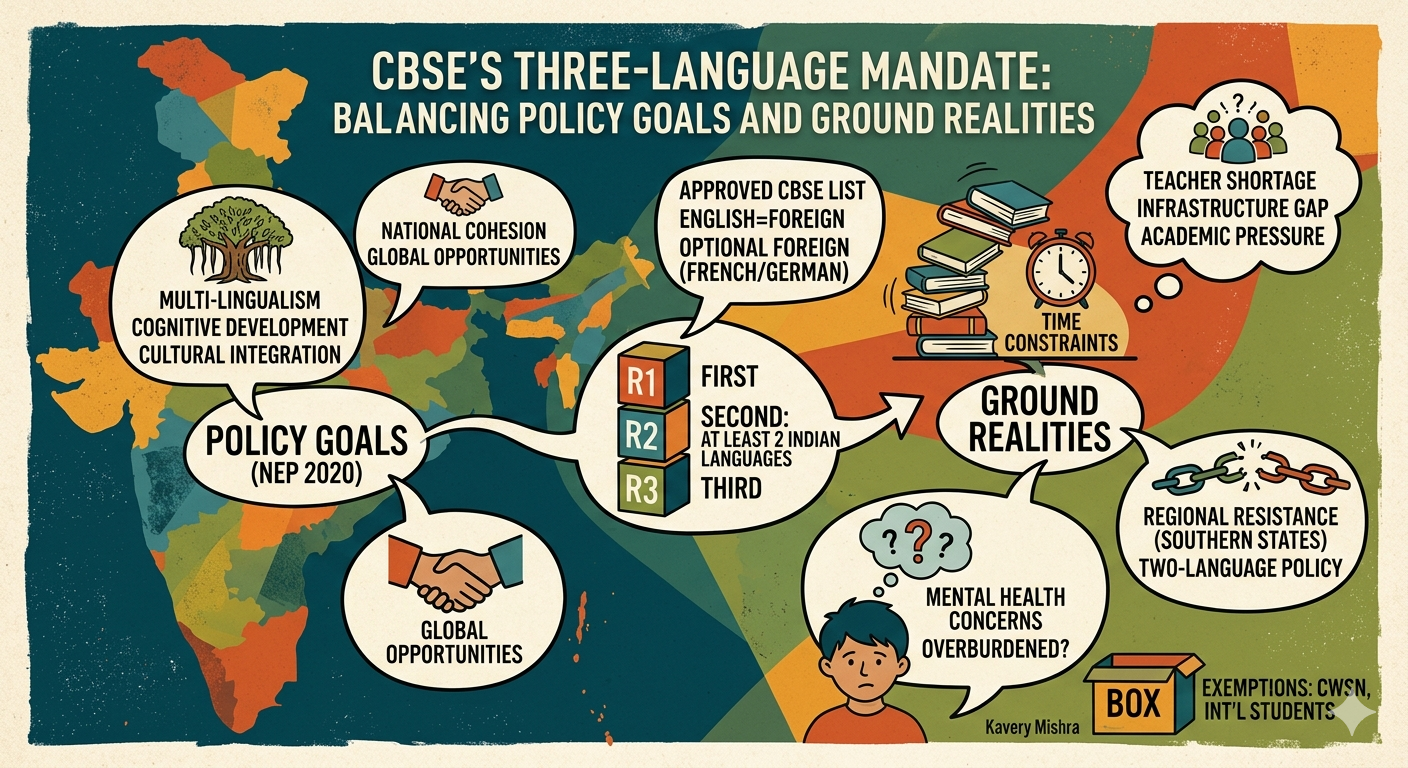
CBSE 3-Language Formula: What Are R1, R2 and R3?
The policy does not impose any specific language on students. Schools and parents can choose languages from the CBSE approved list, provided that at least two of the three selected languages are Indian languages. This means, English it will be considered the foreign language. If students choose another foreign language such as French or German, they must also study two Indian languages.
Under the revised framework introduced by the CBSE, languages will be divided into three categories:
- R1 (First Language): Any language offered by CBSE
- R2 (Second Language): Must be different from R1
- R3 (Third Language): Must be different from both R1 and R2
The policy also mandates that at least two of the three chosen languages must be Indian languages, highlighting its emphasis on multilingualism and linguistic diversity.
Additionally, CBSE has clarified that students cannot study the same language at more than one level at the same time.
One of the major changes introduced by the Central Board of Secondary Education is the compulsory inclusion of the third language (R3) from Class 6 onwards, beginning with the 2026–27 academic session.
The Central Board of Secondary Education has clarified that students must pass all three languages to become eligible for the Class 10 board examinations. The three-language requirement will continue until the complete implementation of the new policy framework. Students currently studying in Class 7 and above must have already studied three languages up to Class 8.
Are Students Being Empowered or Overburdened?
While the move is intended to encourage multilingualism and cultural integration, it has triggered widespread reactions on social media, with many expressing concerns over its potential impact on students’ mental health and academic burden. The new framework requires students to study three languages from Class 6 onwards, with at least two of them being Indian languages. This represents a major departure from the previous system, under which the third language was generally confined to middle school and was often discontinued in higher classes.
Following the announcement, there was an immediate wave of responses from parents, students, and educators. One of the main concerns raised is whether CBSE’s three-language requirement might unintentionally add to students’ academic burden. Many have pointed out that learners are already coping with a packed syllabus, competitive examinations, and various co-curricular demands. In their view, introducing an additional compulsory language could increase stress levels, create confusion, and divert attention from core academic subjects. Some have also cautioned that instead of promoting overall development, such a change could place students under greater pressure.
Implementation Challenges
While the policy sets out an ambitious vision, putting it into practice is likely to be challenging. Several issues have been highlighted in this regard. Sujata Chandra, vice-principal, Indian Public School says, “Schools face real constraints. There is a shortage of trained language teachers, particularly for regional languages. There is an urgent need to redesign curricula and adjust school timetables accordingly. There are challenges with regard to infrastructure and learning resources, especially in smaller or under-resourced schools. Also, there are doubts over whether students can achieve meaningful language proficiency within the available instructional time.”
Experts have pointed out that without careful planning and a phased rollout, the practical burden of implementation could outweigh the intended benefits, ultimately affecting students on the ground.
Constraints
The revised framework has sparked strong political criticism, especially from southern and non-Hindi-speaking states, reigniting the long-standing national debate over language policy.
Article 350A of the Constitution of India requires states to ensure that children belonging to linguistic minority groups receive primary education in their mother tongue. States are not legally bound to adopt the three-language formula. Several states, including Tamil Nadu, Karnataka, and Maharashtra, follow a two-language policy, usually consisting of the regional language and English. Meanwhile, Karnataka, which had earlier rejected the central National Education Policy 2020 framework, has decided to implement its own State Education Policy for government-run schools.
BOX
Despite the criticism, education experts and policymakers maintain that the reform is aimed at achieving long-term educational benefits. The three-language approach is intended to:
- Improve communication abilities and support cognitive development by boosting creativity, flexibility
- Promote awareness and respect for India’s linguistic diversity and cultural understanding
- Equip students for better global opportunities
- Encourage national cohesion through shared language learning
- The third language (R3) could be expected to have certain exemptions and relaxations to interest specific groups of students like children with special needs, foreign or international students coming to India and CBSE schools outside India
Prachi Sharma is a dynamic journalist and anchor known for her insightful reporting and engaging on-screen presence. With a strong command over storytelling and a flair for content creation, she brings clarity and depth to every piece she presents. Prachi’s versatile skills extend beyond journalism—her ability to craft compelling written content makes her a valuable voice in the media landscape. Whether on camera or behind the scenes, she is committed to delivering impactful narratives that inform, inspire, and connect with audiences.

You may like


The Digital India Milestone: Transforming Classrooms with NCERT’s ePathshala
-
Anytime, Anyone, Anywhere: How SWAYAM and UGC MOOCs are Reshaping Learning
-
From Campus to Cloud: How SWAYAM is Democratizing Higher Education
-
CBSE Board Re-evaluation Process: Effects on Academic Performance and Student Confidence
-
Anatomy of a Compromised Exam: From a 400-Question ‘Guess Paper’ to a Nationwide Re-Test
-
Improving Educational Outcomes through Active Stakeholder Participation in Decision-Making in CBSE