Education
Delays, Disruptions and Anxiety: How Technical Glitches Marred CUET UG 2026

Published
7 hours agoon
Authored by trainee: Kaveri Mishra
The National Testing Agency (NTA) has officially cancelled NEET UG 2026, sparking widespread panic, confusion, memes, and intense speculation about the fate of another major entrance examination currently in progress: Common University Entrance Test (CUET) UG 2026. The CUET-UG 2026 entrance test, held for admission to undergraduate courses across the country, was delayed at a few centres due to a technical glitch on May 30, 2026.
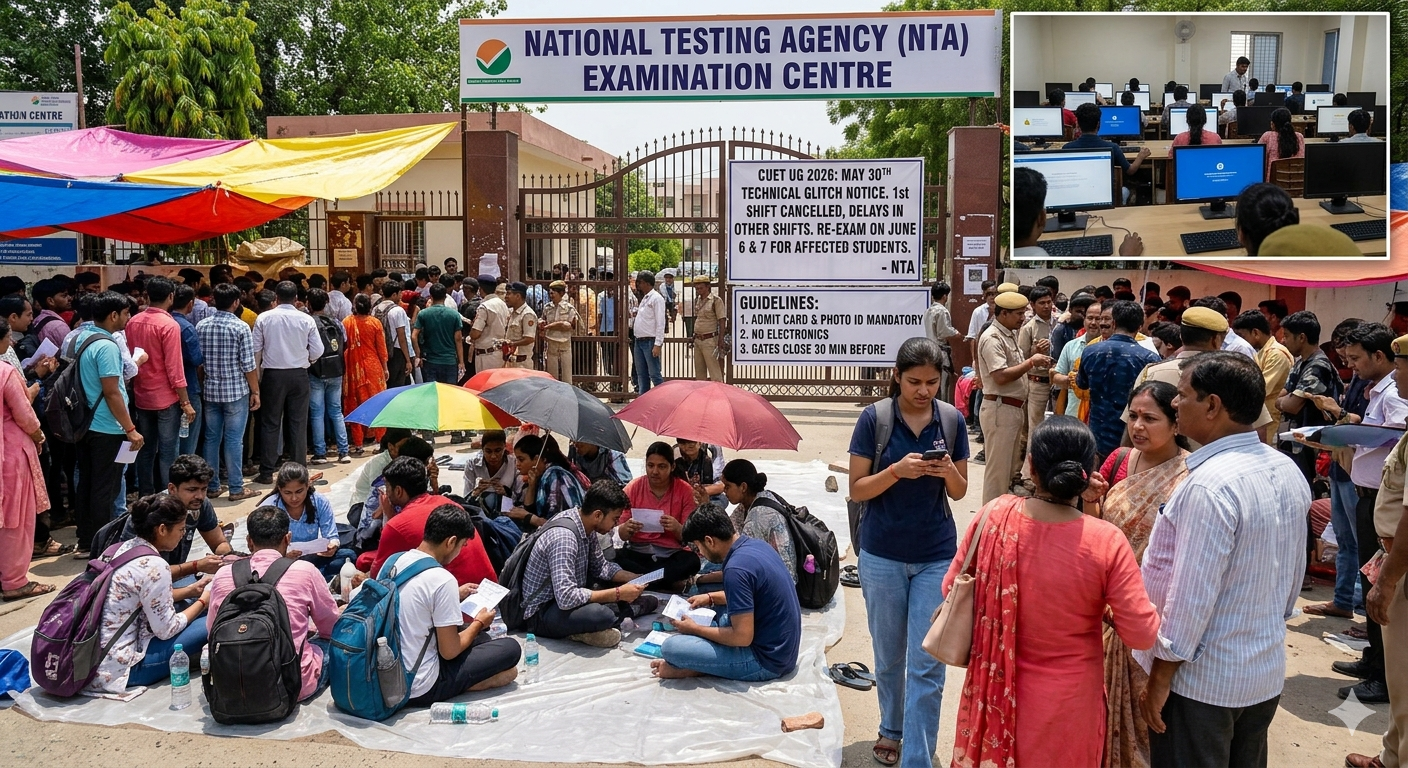
A technical glitch disrupted the first shift of CUET-UG 2026 at multiple examination centres on May 30, leaving thousands of candidates in uncertainty. The incident caused significant stress among students and parents, as over 3,700 candidates who had successfully completed biometric verification were unable to appear for the examination and were forced to leave the centres without taking the test.
CUET was formally launched in 2022 for undergraduate admissions in all Central/participating universities (State/deemed/private) across the country, under the National Education Policy-2020 guidelines. CUET was introduced to create a standardized admission process, ensuring uniformity, equal opportunity, and a level playing field for students from diverse educational backgrounds across the country. However, frequent changes to the exam pattern, delays in result declarations, technical glitches, and concerns over the conduct of the examination have raised questions about the effectiveness and stability of the national-level entrance test. While CUET was envisioned as a transparent and fair gateway to higher education, recurring operational challenges and shifting policies have left students and educators seeking greater consistency and predictability in the admission process.
Wider apprehension
The concerns surrounding CUET UG 2026 are not emerging in isolation. Over the past few years, several major entrance examinations have been marred by recurring controversies, including technical glitches, server outages, city-allocation disputes, admit card issues, last-minute postponements, and allegations of question paper leaks. These incidents have repeatedly raised questions about the reliability and preparedness of exam-conducting agencies, leaving students anxious about the fairness and smooth conduct of high-stakes tests.
The CUET-UG 2026 entrance test, held for admission to undergraduate courses across the country, was delayed at a few centres due to a technical glitch. The incident largely affected the second shift of the examination, forcing students to endure extended waits and uncertainty at multiple test centres. In its official response, NTA attributed the disruption to a technical glitch reported by its technology partner, Tata Consultancy Services (TCS), which impacted the smooth conduct of the examination.
Students’ concern
Sarika Singh, a student who came to Patna from Muzaffarpur to take her CUET exam, said, “A significant technical glitch disrupted the morning session of CUET UG 2026 at multiple examination centres, delaying the start of tests that were originally expected to conclude by 10:30 a.m. Hundreds of students endured wait times ranging from two to four hours before gaining access to their examination halls. After the systems were restored, candidates were granted the full allotted exam duration to ensure that no time was lost.
The impact of the disruption was particularly visible outside the centre, where anxious students and parents crowded the area for hours. Roads around the centre witnessed heavy congestion as long queues stretched across pavements. Under the scorching summer sun, many candidates sat on sheets spread across the ground, using umbrellas for shade, reviewing notes, and waiting anxiously for information about when the examination would begin.
Several candidates alleged that basic amenities were inadequate at a number of examination centres, with complaints ranging from a lack of drinking water and refreshments to insufficient seating arrangements and limited access to washroom facilities. The prolonged delays further added to the discomfort and anxiety experienced by students waiting to appear for the examination.
Anxiousness and turmoil
Among them was Myra Sharma, a candidate at the Patna centre, who described the ordeal as both physically exhausting and emotionally draining. She said, “Having travelled nearly two hours to reach the venue, I was forced to wait for an additional two hours after a server-related technical failure delayed the examination.” According to Sharma, students were left sitting in extreme heat without adequate seating, refreshments, or clear communication from authorities regarding the status of the test.
She also highlighted the psychological impact of the disruption, noting that months of preparation can be undermined by uncertainty on the day of the examination. After enduring hours of waiting in difficult conditions, many students struggled to maintain their concentration and composure, while concerns over possible cancellations, rescheduling, and the value of their preparation only intensified their stress and anxiety.
In response to the disruption, NTA had given a one-time opportunity to 3,765 CUET (UG) candidates who left their examination centres after a technical glitch delayed the commencement of Shift 1 on May 30, to reappear for the entrance examination on June 6 and 7, 2026. The decision was aimed at ensuring that affected students were not disadvantaged due to circumstances beyond their control and could compete on an equal footing with other candidates seeking undergraduate admissions.
BOX
Guidelines to be followed by the students
One should report at least 1-2 hours before the CUET UG 2026 Exam, carry the printed copy of the CUET 2026 Admit card, one original Photo ID, along with 1 transparent ball pen.
The Electronic items, jewellery, calculators and paper are prohibited in the exam, and a mandatory frisking is applicable for all candidates.
The Exam centre gates will close 30 minutes before the exam, with no late entry allowed in the examination hall.
After entering the exam hall, one should verify the allotted seat, subject and the medium displayed on the computer screen.
Prachi Sharma is a dynamic journalist and anchor known for her insightful reporting and engaging on-screen presence. With a strong command over storytelling and a flair for content creation, she brings clarity and depth to every piece she presents. Prachi’s versatile skills extend beyond journalism—her ability to craft compelling written content makes her a valuable voice in the media landscape. Whether on camera or behind the scenes, she is committed to delivering impactful narratives that inform, inspire, and connect with audiences.

You may like


A New Era of Digital Tracking in Higher Education: UAMP Is Revolutionizing Campus Governance in India
-
Merging Theory with Experience: UGC’s Professor of Practice Initiative Brings Industry Expertise to Indian Universities
-
Standardizing the Future: An Overview of the National Testing Agency
-
Fostering Academic Excellence: How the Distance Education Bureau Push for Quality Learning Anywhere


Ski and Snowboard India Elects New Leadership for 2026–2030 Term


Mapping the Campus: How AISHE is Streamlining India’s Higher Education Framework