Education
Seamless Verification: The Integration of NAD and DigiLocker in Indian Higher Education

Published
3 hours agoon
Authored by Trainee Reporter: Adarsh
Indian Higher Education system is a large and growing system with approximately 50 school boards, 400 state universities, 120 deemed universities, 50 central universities and 300 private universities. Apart from these, there are institutions such as IISc/IITs/IIMs/NITs/IISERs/IIITs/NITIE and other centrally funded institutions. These institutions issue various academic awards to students such as degrees, diplomas and certificates along with mark sheets and evaluation reports. Apart from these, institutions under various Ministries/Departments and other skill based institutions also dispense certificates, diplomas and advanced diploma.
So, as educational institutions issue millions of degrees and mark sheets annually, relying on paper records causes several major issues, such as:
Cumbersome Retrieval: Students often face difficulties in obtaining copies of their certificates/mark-sheets whenever they are lost or destroyed as retrieval of old academic records maintained in paper form is cumbersome.
Vulnerability to Damage: Physical documents are easily lost, destroyed by natural hazards, or spoiled over time.
Susceptibility to Fraud: Traditional paper awards can be forged or tampered with, making verification difficult for employers.
Thus, maintaining academic awards in an electronic depository with the help of National Academic Depository provide benefit to educational institutions, students and employers by enabling them to access academic awards online without the need for persons to approach educational institutions for obtaining transcripts of such awards or marks-sheets for verification. It also eliminates fraudulent practices such as forging of certificates and mark-sheets, by facilitating online verifications thereof.
National Academic Depository (NAD): India’s Digital Vault for Academic Awards
National Academic Depository (NAD), launched on 9 July 2017, is an initiative of government of India, under the Ministry of Education (MoE), formerly the Ministry of Human Resource Development (MHRD).
Chronology and Implementation
The ministry has already set up a task force in January 2010 to prepare a road map for implementation of the concept of electronic depository for academic awards.
The National Academic Depository Bill was originally introduced in the Lok Sabha in September 2011. The bill was then referred to the Standing Committee on Human Resource Development. The bill however lapsed in 2014 with the change of Government.
Later, the new Union Cabinet approved a Ministry of Education’s proposal to establishing a digital depository of academic awards to be known as National Academic Depository (NAD) in its meeting held on 27 October 2016.
The Ministry of Education (MoE) has designated University Grants Commission (UGC) as an authorized body to implement NAD as a permanent scheme in seamless integration with the DigiLocker platform.
Core Purpose
It aims at ensuring a credible and convenient mechanism for online lodging, verification and authentication of the academic awards issued by various educational institutions. It facilitates students to get authentic documents/certificates in digital format directly from their original issuers anytime, anywhere without any physical interference.
Core Architecture and Legal Framework
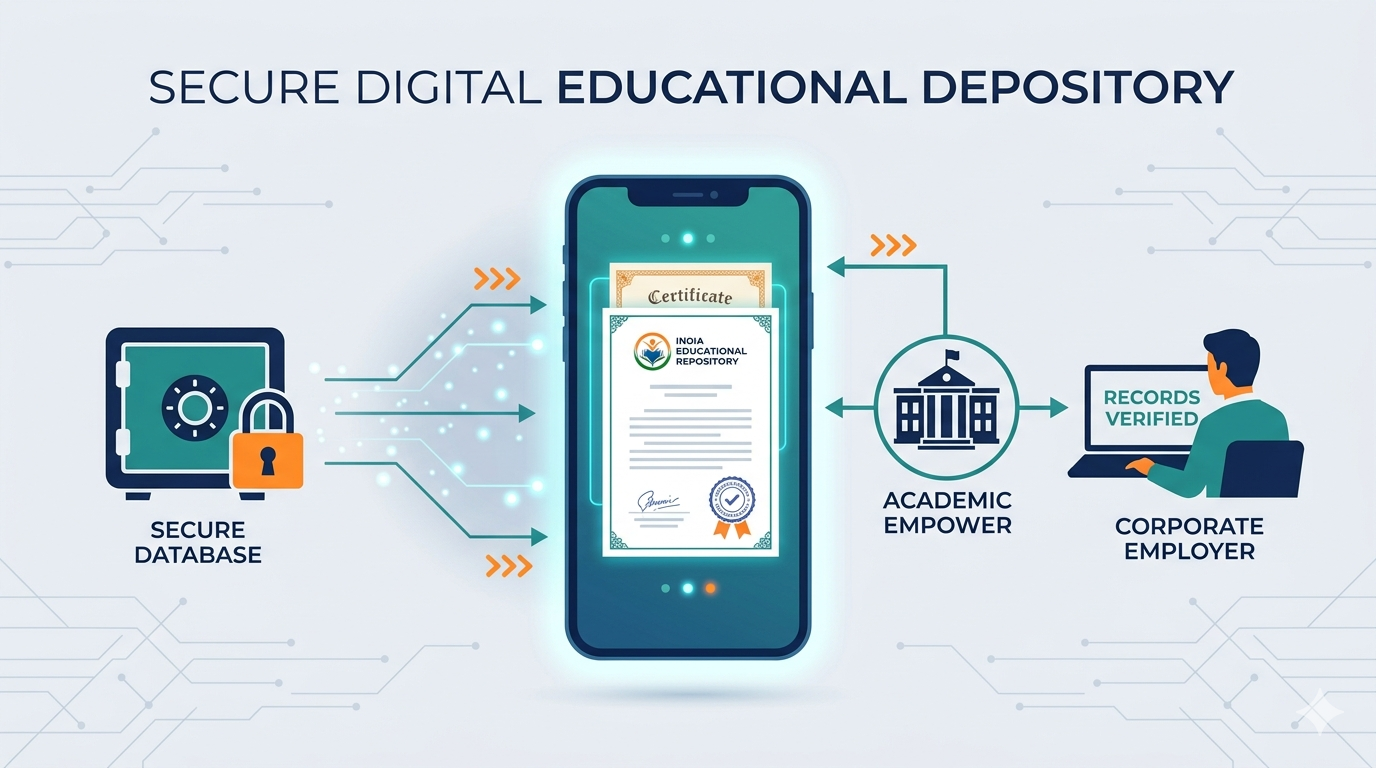
Digital Storehouse: A secure online database where academic institutions directly lodge certificates, diplomas, degrees, and mark sheets.
DigiLocker Integration: Digi Locker, which aims at ‘Digital Empowerment’ of citizen by providing access to authentic digital documents to citizen’s digital document wallet, is a flagship initiative of Ministry of Electronics & IT (MeitY) under Digital India programme.
Legal Validity: Documents in DigiLocker are legally at par with original physical copies under Rule 9A of the Information Technology (Preservation and Retention of Information by Intermediaries providing Digital Locker facilities) Rules, 2016.
Key Stakeholders of NAD
Students: End-users who can access and share their credentials digitally anytime, anywhere.
Academic Institutions/Boards: Authorized original issuers who lodge authentic academic awards (certificates, diplomas, mark-sheets) directly into the digital storehouse.
Verifying Partners: Employers and other educational institutions who can authenticate credentials in real-time.
NAD Repository & DigiLocker: The digital infrastructure maintaining the confidentiality, integrity, and availability of the database.
Primary Benefits of NAD
There are various benefits of NAD, such as:
Permanent Digital Storage: NAD replaces physical paper records with secure digital copies that cannot be lost or damaged. Records are permanently stored and accessible from anywhere.
Eliminates Document Fraud: By ensuring certificates are uploaded directly by authorized boards and universities, NAD prevents the forging and tampering of paper certificates.
Instant Digital Verification: Employers and educational institutions can verify a student’s academic credentials in real-time with the student’s consent, drastically cutting down hiring and admission delays.
Reduced Administrative Burden: It saves educational institutions from the tedious task of printing duplicate certificates, issue physical degrees, etc.
Seamless Accessibility (DigiLocker): Integrated with the DigiLocker platform, students can easily retrieve, share, and present their academic credentials for jobs, higher education, or government services.
Prachi Sharma is a dynamic journalist and anchor known for her insightful reporting and engaging on-screen presence. With a strong command over storytelling and a flair for content creation, she brings clarity and depth to every piece she presents. Prachi’s versatile skills extend beyond journalism—her ability to craft compelling written content makes her a valuable voice in the media landscape. Whether on camera or behind the scenes, she is committed to delivering impactful narratives that inform, inspire, and connect with audiences.

You may like


Mapping the Campus: How AISHE is Streamlining India’s Higher Education Framework


The Digital India Milestone: Transforming Classrooms with NCERT’s ePathshala
-
Anytime, Anyone, Anywhere: How SWAYAM and UGC MOOCs are Reshaping Learning
-
CBSE’s Three-Language Mandate: Balancing Policy Goals and Ground Realities
-
From Campus to Cloud: How SWAYAM is Democratizing Higher Education
-
CBSE Board Re-evaluation Process: Effects on Academic Performance and Student Confidence